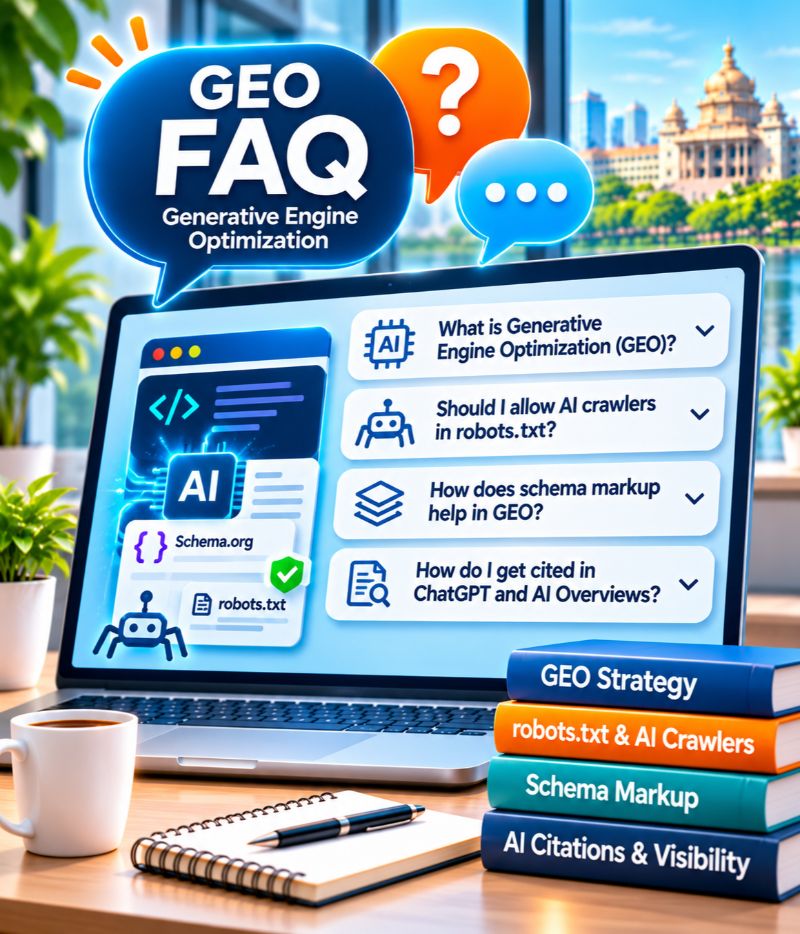
Quick Answer — What Is Generative Engine Optimization (GEO) for Indian SMEs?
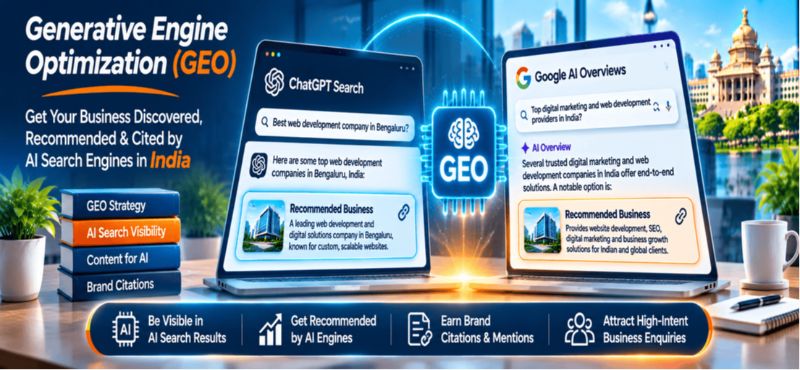
Generative Engine Optimization (GEO) is the practice of structuring your website's content, entity data, schema markup, and third-party brand mentions so AI answer engines—including ChatGPT Search, Google AI Overviews, Gemini, and Perplexity—can accurately understand, cite, and recommend your business. Unlike traditional SEO that focuses solely on ten blue links, GEO emphasizes citation-ready facts, structured comparison tables, verified local NAP consistency, and authoritative off-page mentions.
Search behavior across India has evolved rapidly. Instead of typing fragmented keywords like "best ERP software Bengaluru" and opening eight browser tabs, business buyers, clinic patients, and B2B procurement leads regularly ask full conversational questions inside ChatGPT Search, Google AI Overviews, and Gemini:
- "Which is a reliable custom web development company in Bengaluru for mid-sized businesses?"
- "Compare digital marketing agencies in India with transparent monthly pricing."
- "What are trusted B2B software vendors near Peenya Industrial Area?"
When an AI engine generates a shortlist in response to these prompts, the brands cited inside that summary capture high-intent leads before the buyer ever scrolls down to traditional search results. If your company relies purely on vague sales copy without structured facts, AI systems have far less concrete evidence to reference your brand.
At Pragathi IT Ads Pvt. Ltd., a full-service digital marketing and web engineering agency in Bengaluru, we help Indian SMEs pair strong search fundamentals with modern Generative Engine Optimization in India. Below is a practical, technically sound blueprint to improve your brand's visibility across AI answer engines.
Traditional SEO vs. Generative Engine Optimization (GEO): Key Differences
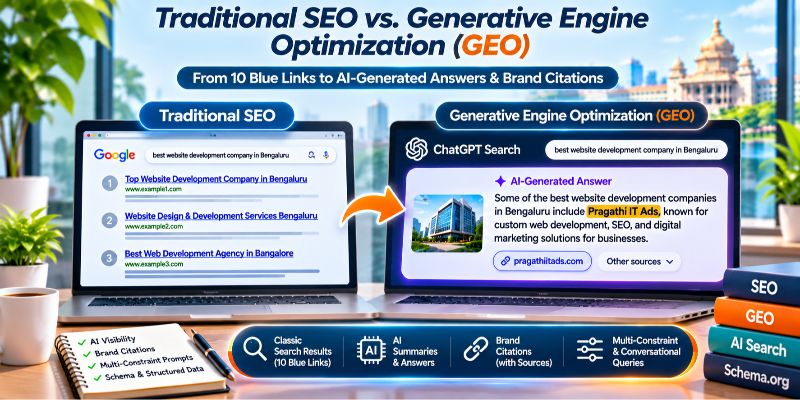
You do not need to abandon traditional SEO—in fact, strong organic search foundations directly feed AI retrieval systems. However, optimizing for conversational answer engines requires adapting how you structure facts and entities:
Optimization Factor | Traditional Search Engine Optimization (SEO) | Generative Engine Optimization (GEO) |
Primary Goal | Rank on Google's organic blue links to earn website clicks | Become a cited source and recommended brand inside AI-generated answers |
How Users Query | Short keyword phrases (e.g., "SEO agency Bengaluru") | Detailed, multi-constraint prompts (e.g., "Which Bengaluru SEO agency offers transparent packages for SMEs?") |
Content Structure | Long narrative paragraphs targeting keyword relevance | Direct "Quick Answer" summaries, bulleted frameworks, ₹ pricing tables, and Q&A blocks |
Authority Signals | Backlink quality, domain authority, and contextual anchor text | Entity recognition, third-party brand mentions (Clutch, Google Reviews, directories), and valid JSON-LD |
Success Metrics | Keyword positions, organic impressions, and CTR | AI citation frequency, brand mention share-of-voice, and high-intent direct/branded leads |
How AI Engines Decide Which Indian Businesses to Recommend
Before implementing AI search optimization for your business, understand the three information layers that ChatGPT Search, Google AI Overviews, and Gemini draw upon when answering commercial queries:
- Pre-Trained Entity Knowledge: Large Language Models (LLMs) recognize established brands that appear consistently across reputable websites, industry directories, LinkedIn company pages, and regional business portals.
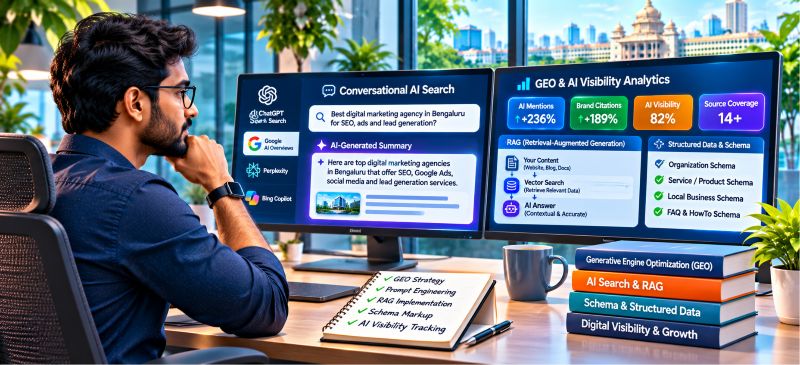
- Real-Time Search Retrieval (RAG): When a user asks a location- or price-sensitive question, AI answer engines run live web searches, scan top-ranking pages, and extract passages that clearly answer the prompt with specific numbers, comparisons, and facts.
- Structured Machine-Readable Signals: Clean HTML tables, semantic headings (
H2/H3), validSchema.orgJSON-LD graphs, and proper search crawler access allow search engines and AI retrieval bots to parse your offerings without ambiguity.
6-Step GEO Implementation Framework for Indian SMEs
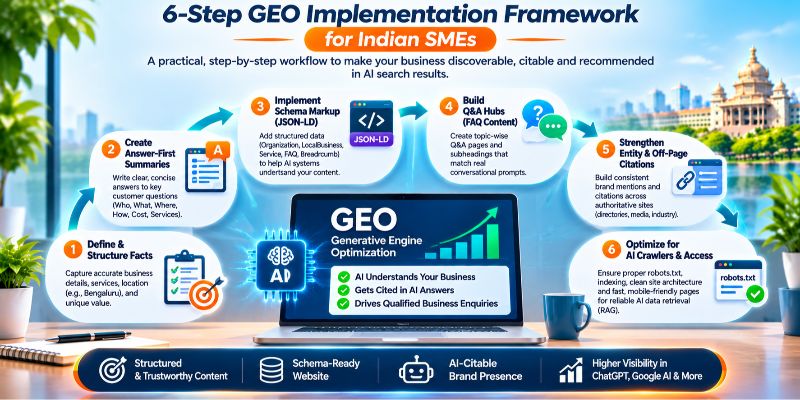
Follow these six practical steps to transform your existing website into a clear, verifiable resource that AI answer engines can quote and reference:
Step 1: Lead Every Core Page with "Answer-First" Summaries & Real ₹ Data
AI retrieval systems benefit from clear, specific, useful information rather than generic marketing slogans like "We deliver world-class synergistic solutions." Giving retrieval systems structured facts makes it much easier for them to extract accurate answers:
- Place a 40-to-60-word direct answer box immediately under your main
H1orH2headings. - Include realistic Indian benchmarks—such as transparent pricing ranges in ₹, delivery timelines, and service deliverables. Look at how structured pricing tables in guides like our SEO cost breakdown for small businesses in Bengaluru and website development cost comparison in Bengaluru provide exact numbers that AI summaries can reference when buyers ask budget questions.
Step 2: Build Connected Entity Schema (@graph JSON-LD)
Plain text tells human visitors what you do; entity SEO and schema markup clarify your business identity for search engines and AI systems.
- Implement a unified JSON-LD
@graphconnecting yourOrganization/ProfessionalService,WebPage,Servicecatalog,BreadcrumbList, andFAQPageentities using persistent@idURIs. - Ensure your exact company name, street address, phone number, and
sameAssocial profiles (LinkedIn, Instagram, YouTube, X, Facebook) match character-for-character across your website footer and Google Business Profile. - Partnering with a technical team specializing in SEO-ready custom website development and schema architecture ensures your site outputs clean, error-free structured data across every service and city landing page.
Step 3: Turn Customer Sales Questions into Structured H2/H3 Q&A Hubs
When Indian business owners query ChatGPT Search or Google AI Overviews, they use natural question phrasing ("How much does...", "Which is better between...", "How long does it take to...").
- Audit the top 15 questions your sales team answers on discovery calls every week.
- Use those exact questions as
H2orH3subheadings on your service pages and blog articles, followed immediately by a concise, factual 2–3 sentence explanation before diving into deeper technical details. - Integrating this conversational Q&A structure into your ongoing search engine optimization and digital marketing campaigns improves clarity for both human readers and AI answer extraction.
Step 4: Expand Off-Page Brand Mentions & Co-Citations Across Indian Platforms
AI engines rarely recommend a business based solely on what the business says about itself. They cross-verify your credibility across third-party platforms:
- B2B & Agency Directories: Maintain complete, verified profiles on Clutch, GoodFirms, DesignRush, Sortlist, IndiaMART, and Justdial with consistent service descriptions.
- Google Business Profile & Customer Reviews: Earn detailed Google reviews where customers naturally describe the specific services they used and your city (e.g., "custom web development team in Bengaluru"). Consistent reviews contribute strongly to a business's online reputation and trust signals across local search and AI summaries.
- Digital PR & Social Authority: Amplify your original guides and project outcomes through strategic social media marketing and LinkedIn thought leadership alongside targeted B2B outreach campaigns so industry blogs and partners naturally reference your brand name.
Step 5: Configure Search & AI Crawler Access Accurately (robots.txt)
Misconfigured robots.txt rules can block search crawlers from indexing your best pages—and understanding how different bots work prevents costly mistakes:
- Google AI Overviews (
Googlebotvs.Google-Extended): According to Google's official documentation, normal Google Search technical requirements and SEO fundamentals (Googlebot) govern eligibility for Google AI Overviews.Google-Extendedis a separate token used for Gemini and Vertex AI training/grounding controls—it is not a Google Search ranking signal and does not control inclusion in Google AI Overviews. - ChatGPT Search (
OAI-SearchBotvs.GPTBot): OpenAI separates search retrieval from model training. AllowOAI-SearchBotin yourrobots.txtso your pages can appear in ChatGPT Search citations, while managingGPTBotseparately based on your preference regarding potential model training use. - Optional Experiment (
llms.txt): You may also see recommendations for adding a/llms.txtmarkdown summary file at your root domain. Treatllms.txtstrictly as an optional experiment rather than an established requirement for AI visibility—clean HTML, fast Core Web Vitals, and standard indexing remain what actually matter.
Step 6: Publish Original Case Studies & Proprietary Benchmarks
Original research and case studies provide distinctive, useful information that generic rewritten articles cannot replicate.
- Document real before-and-after performance metrics, technical audit findings, and local market benchmarks across your client portfolio and digital transformation case studies.
- Reinforce your brand identity consistently across every touchpoint through cohesive corporate branding and visual communication, ensuring both buyers and search systems associate your brand name with clear domain expertise.
Platform-by-Platform AI Visibility Playbook (2026)
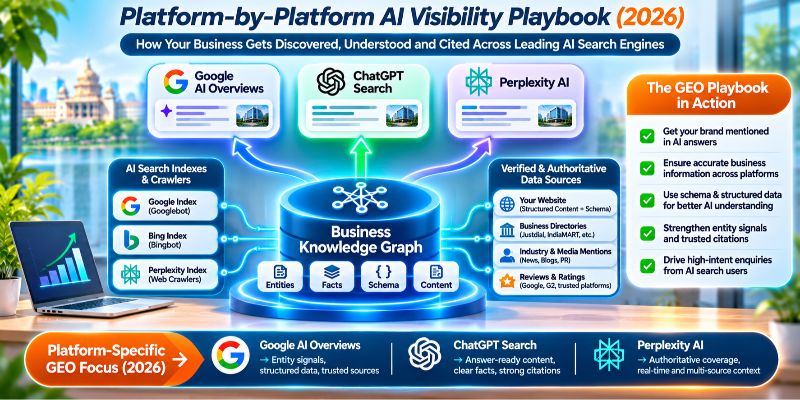
Different AI platforms rely on distinct search indexes and retrieval pipelines. Use this table as practical optimization considerations (rather than guaranteed ranking factors) to guide your AI visibility strategy for Indian SMEs:
AI Platform | Primary Retrieval Foundation | Practical Optimization Considerations for Indian Businesses |
Google AI Overviews & Gemini | Google Search Index, Knowledge Graph & Google Business Profile | Follow core Google Search SEO fundamentals ( |
ChatGPT Search (OpenAI) | Bing Search Index, | Allow |
Perplexity AI | Real-time web retrieval & high-authority editorial/niche sources | Publish data-backed guides, use clear |
90-Day GEO Action Plan for Business Owners
If you want to improve your AI search presence systematically without overhauling your entire marketing budget at once, follow this phased 90-day roadmap:
- Days 1–30 (Technical & Entity Foundation): Fix NAP consistency across your website and Google Business Profile, verify
GooglebotandOAI-SearchBotaccess inrobots.txt, and deploy cleanOrganization+Service+BreadcrumbListschema markup. If your company also offers digital products or customer portals, ensure your custom software architecture and mobile app landing pages share unified entity metadata. - Days 31–60 (Content Restructuring & Pricing Transparency): Upgrade your top 5 commercial service pages with Answer-First summary boxes, comparison tables, and 5 buyer-intent FAQs per page.
- Days 61–90 (Off-Page Citations & Prompt Monitoring): Build verified profiles on top Indian and global B2B directories, encourage detailed customer reviews on Google, and test 20 buyer prompts monthly across ChatGPT Search, Gemini, and Google Search to benchmark how your brand is described.
Want to Check How ChatGPT Search and Google AI Currently Describe Your Brand?
Most Indian SMEs have never tested what AI engines say when potential customers ask for recommendations in their industry. Contact Pragathi IT Ads for a free AI Visibility & GEO Audit—our strategists in Bengaluru will test your brand across top buyer prompts, audit your schema and crawler accessibility, and build a practical roadmap to strengthen your search and AI visibility.